
Jimpa (Blu-ray Review)
Director
Sophie HydeRelease Date(s)
2025 (April 21, 2026)Studio(s)
Closer Films/Mad One Films/Viking Film (Kino Lorber)- Film/Program Grade: B
- Video Grade: A
- Audio Grade: A
- Extras Grade: B-

Review
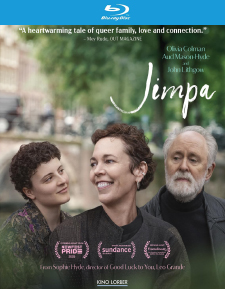
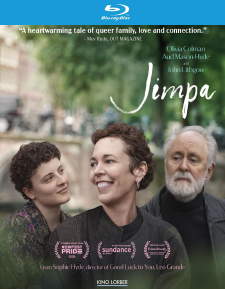
Semi-autobiographical, Jimpa (2025) slightly fictionalizes director and co-writer Sophie Hyde’s relationship with her aging father, later a prominent LGBTQIA+ activist who came out gay in the 1970s, while married with children. The film stars Olivia Colman as the Hyde character, John Lithgow as the father, and Aud Mason-Hyde as the filmmaker’s nonbinary teenage offspring.
Filmmaker Hannah (Colman), her husband, Harry (Daniel Henshall), and their child, nonbinary Frances (Mason-Hyde), travel from their native Australia to Amsterdam to visit Hannah’s father, university professor and LGBTQI activist Jim (Lithgow), who has mostly recovered from a stroke three years ago. Frances, anxious to explore their sexuality, wants to live with “Jimpa” for a year, but Hannah is worried that her father’s unfiltered, selfish sanctimonious ways (among other things) might hurt Frances in the long run. Frances, however, idolizes Jimpa as a completely liberated gay man living life to the full in an idyllic, progressive city where, sexually speaking, anything goes.
In Amsterdam, Jimpa is warm and welcoming and outspoken, at times a little overbearing, introducing the family to his mostly gay friends, though the entire gender spectrum is seemingly represented. He embraces the idea of Frances staying with him, but contradictorily has also applied for a job in Norway. Further, his older generational views, as an AIDS survivor but, mostly, as someone who believes one is either straight or gay/lesbian full-stop, puts both Hannah and Frances in an awkward position. Hannah has enormous empathy for Frances, and though she’s still a teenager, is respectful of Frances’s identity and permissive of Frances’s search for sexual self, but she’s not protective when Jimpa is critical and dismissive of her nonbinary status.
The theme-crammed film thus primarily focuses on the conflicts of these characters: Hannah trying to come to terms with her aging father, she suppressing underlying conflicts between them, as well as a child on the cusp of adulthood and independence; Jimpa adamantly resisting his diminishing physical state; and Frances inching toward adulthood and trying to figure out where her gender identity figures into that.
The big draw of Jimpa is, of course, the performances of Colman and Lithgow, which don’t disappoint. Lithgow, a fine actor whose talents are too often wasted in trivial films, delivers what may be his best role since playing the transgender former football pro in The World According to Garp, and that was 44 years ago. In his late 70s when Jimpa was made, Lithgow holds nothing back, literally, including several startling moments of full-frontal nudity. Both he and Colman create fully-dimensional characters that are completely believable. The director’s real-life offspring, Mason-Hyde, is also very good as Frances.
My biggest complaint about Jimpa is a recurring flashback device that director Hyde uses almost obsessively throughout the film. When, for instance, Hannah, gazes at her aging father, Hyde will cut to fleeting images from decades earlier, with other actors playing younger versions of Jim, Hannah, etc. Beyond the fact that the actors all so vividly recount their pasts (which allows the movie audience to imagine past events for themselves), it renders the too-literal flashbacks as mostly redundant and unnecessary. Further, the actors playing younger versions of Jim particularly, don’t look like younger versions of Lithgow et. al., and combined with the quick-cutting, at times these flashbacks even generates a little confusion at times.
Elsewhere, the film seems to be trying to encapsulate the entire LGBTQIA+ experience and a half-century of history besides, running the risk of becoming first and foremost a kind of queer film polemic where story and character become secondary. Thankfully, though, it’s so personal, direct, and compelling that it ultimately holds together.
Filmed digitally for 1.85:1 projection, Kino’s Blu-ray of Jimpa is up to contemporary standards, the image is clean with good color. Director Hyde favors a shallow depth-of-field, so there are a lot of shots where the focus is on a narrow plane, etc. The DTS-HD Master Audio is offered in 5.1 surround and 2.0 stereo mixes, with optional English subtitles provided on this Region “A” release.
Extras are the usual stuff for a new release: deleted scenes, cast and crew interviews, and a trailer.
Jimpa is worth seeing for the performances of Olivia Colman and John Lithgow, its personal and true story brought to the screen, and for the enlightenment it brings to audiences of its very unconventional family dynamic. Recommended.
- Stuart Galbraith IV