
Conversation Piece (Blu-ray Review)
Director
Luchino ViscontiRelease Date(s)
1974 (May 5, 2026)Studio(s)
Rusconi Film/Gaumont (Raro Video/Kino Lorber)- Film/Program Grade: A-
- Video Grade: B+
- Audio Grade: A
- Extras Grade: B

Review
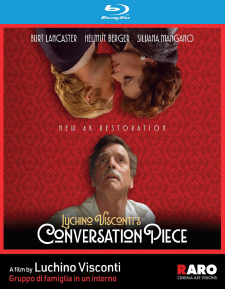
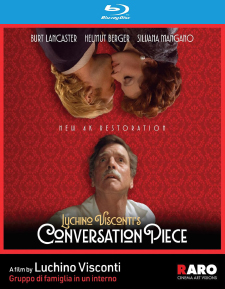
The penultimate work of Italian auteur Luchino Visconti (The Leopard), Conversation Piece (Gruppo di famiglia in un interno, 1974) tells a very strange yet beguiling story, virtually all of it taking place within a single Italian palazzo (a large, urban residence, like a Victorian townhouse). Visconti smoked six packs of cigarettes per day, resulting in a debilitating stroke in 1972. Nevertheless, star Burt Lancaster stepped up and financially guaranteed the film’s completion, with or without Visconti, since no insurance company would cover the ailing filmmaker.
In the film, the actors all speak English, though some of the Italians are dubbed, while Lancaster and co-star Helmut Berger were dubbed for the Italian release. Raro Video’s Blu-ray includes both versions, defaulting to the English audio track, which is recommended in this case.
Lancaster plays a retired (and never named) American Professor, whose mother was Italian, he living in her enormous palazzo since the end of the war. He lives there alone save for his housekeeper, Erminia (Elvira Cortese), enjoying a peaceful, solitary life, surrounded by his books and dozens of paintings, which cover nearly every square-inch of wall space.
The film opens with rich, entitled, and extremely pushy Countess Brumonti (Silvana Mangano) all but barging into the Professor’s home uninvited, she insisting on renting the palazzo’s long-vacant upstairs apartment. He refuses, but the Countess’s much younger kept lover, Konrad (Berger), her underage daughter Lietta (Claudia Marsani), and Lietta’s fiancé Stefano (Stefano Patrizi) wear the Professor down and he reluctantly agrees.
Immediately, however, following an enormous racket upstairs and water pouring in through the Professor’s walls, he discovers the apartment completely gutted as the Countess is having the entire space rebuilt, without the Professor’s prior knowledge or permission. (Later, its ghastly modern makeover is revealed, aesthetically completely at odds with the building’s classical architecture, like something out of a Dario Argento giallo.) Further, the hedonistic family casually strolls into the Professor’s home at all hours to use the phone, ask for food, and Konrad, Lietta, and Stefano engage in drug use and have threesome sex there.
Strangely, though, despite these seemingly unpardonable, intolerable violations of the lease, the Professor, though angry and disturbed by their actions, maintains his composure and is unexpectedly forgiving. Despite their constant clashing, he’s strangely drawn to them as a kind of surrogate family, especially Konrad, who is knowledgeable of art and classical music like the Professor, and these interactions after decades of comparative solitude animate and intrigue him. When, for instance, thugs break into the upstairs apartment and viciously beat Konrad, the Professor nonjudgmentally hides him in a hidden bedroom used by his mother to hide Jews and partisans.
Conversation Piece is a fascinating watch, though it disappoints a little toward the end, when its resolution, inevitable though it may be, doesn’t surprise like all that comes before. Lancaster is magnificent as the Professor, a placid figure who, in the first scene, is talking with art dealers who want to sell him a valuable painting he admires but refuses to buy. The sequence demonstrates his low-key assertiveness, which is immediately tested after, and his world turned on its side, by the unctuous Countess and her brood. He surrounds himself with paintings of strangers from centuries past who, prior to his unwanted tenants, he treats like close personal friends, in monologues beautifully delivered by the actor. There are also well-staged flashbacks with the Professor’s dead wife (Claudia Cardinale, fleetingly) and mother (Dominique Sanda, in another cameo) which work because of the staging: the Professor’s mind wanders as he imagines them in the same room—seated in a chair, gazing out a window.
The voices of Lancaster, Berger, Mangano, and some of the other actors are heard on the soundtrack, while Marsani and Patrizi are obviously dubbed by others. The dubbing is generally good if a little stilted, but which sort of works since their characters are so self-absorbed and superficial.
Visconti’s usual themes—generational clashes, conservative vs. progressive politics and activism, contemplative characters facing aging and mortality—are present, sometimes a little shoehorned here and there, but overall the film, at least for me, is more engaging and intriguing than Death in Venice (1971), Visconti’s much more famous late-career drama, which explores some of the same themes.
Raro Video’s Blu-ray of Conversation Piece, a Region-Free disc released through Kino Lorber, utilizes a 2019-2023 4K restoration of the original camera and sound negatives, completed in Italy. Filmed in Todd-AO 35, the 2.35:1 image is a little disappointing—good but not as great as it should be, sharp but not pristine, though acceptable. The exquisite production design for this film, shot entirely on soundstages owing to Visconti’s health, come off best on big projector systems, where their detail and Visconti’s use of color can best be appreciated. At least one other reviewer criticized the transfer for allegedly excessively stretching of the anamorphic image, but any stretching was imperceptible to my eyes, and that’s the kind of thing that would drive me nuts. Audio for both versions is DTS-HD Master Audio 2.0 mono. I only briefly sampled the Italian track but the English one is excellent for what it is, and the optional English subtitles are likewise good.
Special Features consist of an audio commentary track by film critic Bilge Ebiri and an archival featurette, an interview with film critic/screenwriter Alessandro Bencivenni. What’s billed as a theatrical trailer instead seems to be instead a new promotional trailer created by Raro, though it may have preceded revival screenings.
As with John Huston’s final film, The Dead (1987), likewise directed from a wheelchair, Conversation Piece demonstrates what’s possible when an ailing filmmaker still has much left to say, turning physical limitations into an advantage. It’s one of Visconti’s best films, and Highly Recommended.
- Stuart Galbraith IV