
King David (Blu-ray Review)
Director
Bruce BeresfordRelease Date(s)
1985 (February 25, 2026)Studio(s)
Paramount Pictures (Imprint Films/Via Vision Entertainment)- Film/Program Grade: B-
- Video Grade: A
- Audio Grade: A
- Extras Grade: B-

Review
[Editor’s Note: This is a Region-Free Australian Blu-ray import.]
Hollywood-made biblical epics, particularly popular from the late-1940s through the mid-1960s, had been all but dormant for years following George Stevens’s disastrous $20 million The Greatest Story Ever Told (1965), which earned just $12.1 million worldwide during its original run. The genre eventually moved to long-form television, including the miniseries Jesus of Nazareth (1977) and Masada (1981). Nevertheless, Paramount’s Michael Eisner hoped to revive it theatrically with King David, hiring Breaker Morant’s Bruce Beresford to direct.
At the time of its release, the film was ridiculed by critics for casting Richard Gere in the title role. He is indeed miscast, but the film’s larger problems have to do with its script (by Andrew Birkin and James Costigan), which tries to cram a three-and-a-half-hour story (at least) into a 114-minute movie. It is, however, a handsome-looking production featuring several splendid performances, a good musical score (by Carl Davis, best known for his collaborations with Kevin Brownlow), cinematography (by Donald McAlpine) and production design (by Ken Adam).
In 1000 B.C., Saul, King of Israel (Edward Woodward), breaks his covenant with God by failing to destroy the Amalekites. Prophet Samuel (Denis Quilley) insists Israel requires a new king, anointing peasant David (played by Ian Sears), but initially David rejects the prophecy. Later though, during a battle with the Philistines, David successfully challenges their champion, the giant Goliath (Euro-film icon George Eastman, who died this past May), David soon becoming a celebrated warrior in Saul’s Army.
But as the popularity of David (now played by Gere) grows, Saul becomes paranoid, believing David will usurp his title to the throne. He orders David be brought to him, but David flees, seeking refuge with the High Priest Ahimelech (Hurd Hatfield), keeper of the Ark of the Covenant (possibly the same prop used in Raiders of the Lost Ark), and later with Achish, Lord of the Philistines. Eventually crowned King of Israel, David’s vanity and disregard for his prophets’ guidance leads to his downfall, especially after David arranges for the killing of the loyal Uriah (James Lister) so that he can marry the beautiful but manipulative Bathsheba (Alice Krige).
20th Century Fox’s earlier David and Bathsheba (1951), like King David, was initially conceived as a film that would cover David’s life story, but the studio wisely pressured screenwriter Philip Dunne to refashion his narrative in a more manageable length by focusing on the relationship of the title characters (played in that film by Gregory Peck and Susan Hayward). King David writer Birkin himself felt the material better-suited to a 10-hour miniseries. Crammed into just under two hours, except for David and, to a lesser extent, Saul, there’s never time to develop its myriad characters. On one hand, it tries to incorporate even minor biblical names, but even the big ones come and go with such brevity there’s no time to really flesh out anybody. Bathsheba, for instance, has one important scene, then lingers around the fringes for the remainder of the film. Nor is there enough screentime to fully understand David obsession with her, beyond a fleeting nude scene by the alluring Krige. (Cherie Lunghi, as David’s first wife, Michal, also appears nude, also fleetingly, though she has more to do than Krige.)
Unlike Martin Scorsese’s revisionist The Last Temptation of Christ, released three years later, King David, mostly falls within the classic biblical epic genre. Carl Davis’s music emulates the big scores of Tiomkin, Rózsa, and Bernstein, for instance, and though inflation precluded the building of gargantuan sets, it uses real historic sites (in Italy) well, augmented by Ken Adam’s flourishes.
Nevertheless, the battle scenes are impressively staged, and in a couple of shots, uses the same multiple exposure effect Stanley Kubrick created for Spartacus to triple the number of extras playing soldiers. The hand-to-hand combat is notably more graphic and realistic than earlier biblical epics. In virtually all such films, for instance, horses always miraculously escape injury—look at photographs of World War I battlefields and dead horses are everywhere—but here we see them arrowed, etc.
The writers also show restraint in avoiding supernatural miracles and the like; even Goliath is just an unusually large man. This allows a reading of the film perhaps not intended, that Saul and David, the prophets and the others are simply interpreting what they think is God’s will, and that their interpretations lead to much unnecessary suffering.
As for Gere, he’s not bad in the film’s intimate scenes, playing opposite one or a couple of other actors, but he’s completely out of his depth in the film’s more political moments, addressing advisors or his adoring followers, coming off as shallow and lightweight. This kind of part calls for either a larger-than-life actor (such as Charlton Heston) or a mortal portrayal requiring a better actor than Gere.
Conversely, the rest of the cast is excellent, though only Edward Woodward gets enough breathing room to fashion a three-dimensional character. He, however, is magnificent. Quilley, Hatfield, and John Castle are also good.
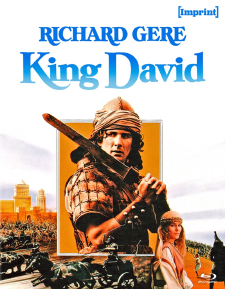
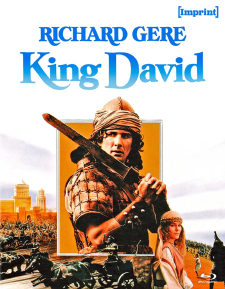
Australia’s Imprint label has released King David as a Region-Free disc. It seems to utilize the same video transfer as Paramount’s 2022 Blu-ray release in the U.S., the 2.39:1 Panavision image looking splendid with excellent sharpness, color, and contrast. The LPCM 2.0 stereo also impresses, adding weight to Davis’s score and full of directional sound effects. Optional English subtitles are provided.
Unlike the Paramount release, which had no extra features, Imprint’s Blu-ray includes a new audio commentary by film historian Jim Hemphill, and a new featurette, Films to Restore the Soul: A History of Religious Cinema.
After avoiding it for many decades, I’m glad to have finally gotten around to seeing King David. It’s better than its reputation, not great but containing many fine components. Recommended.
- Stuart Galbraith IV